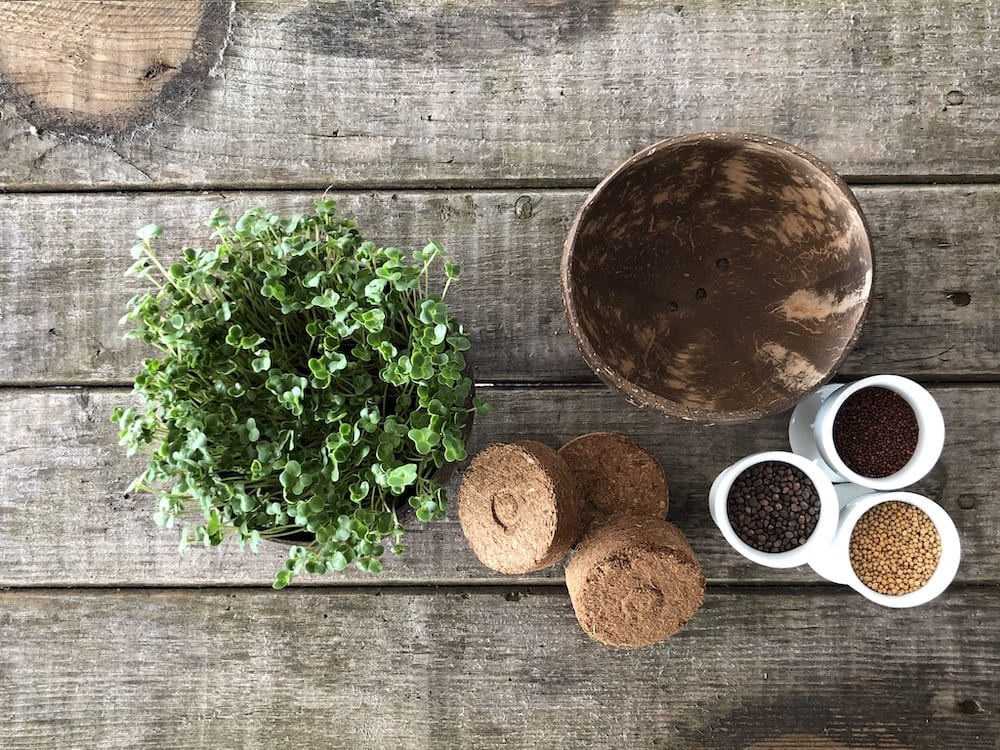
Did you know that Microgreen taste more intense than full-grown vegetables?
You don't have to believe us, but you could try it out and put it to the test: Get a small bowl of cress from the supermarket or your favorite health food store and sprinkle a handful of cut leaf stems on your crispy bread, over your soup or your favorite -Pizza... bet you can clearly taste the whimsical little baby greens between all the ingredients?
, the fact that the leafy green tickles our taste buds to the extreme is not its only advantage... because there are also the incredible number of vitamins , the all-round availability , the simplicity and so much more! But everything in order, because we can easily get excited and enthusiastic about the potential of the little green button wonders 😉
Incredibly many vitamins and nutrients

Microgreens contain up to 200x more vitamins and nutrients per gram than full-grown vegetables from the supermarket.
The germination process leads to an increase in the already abundant vital substances and nutrients, vitamins, enzymes, minerals and trace elements - no vegetables from the supermarket can keep up with that!
Microgreen contain important minerals such as magnesium, calcium and iron . There are also plenty of secondary plant substances and antioxidants .
essential oils and bitter substances that are so important to us are formed during growth . These in turn stimulate digestion and blood circulation , have a blood-purifying and keep viruses, bacteria and fungi away .
Here is another concrete numerical example: A red cabbage Microgreen has 260 times as much beta-carotene, 6 times as much vitamin C and 40 times as much vitamin E per gram as a full-grown red cabbage (source: Journal of Agricultural And Food Chemistry).
Broccoli Microgreen are characterized by a particularly high content of the antioxidant sulforaphane a mustard oil glycoside). In microgreens, this proportion is 50 to 100 times higher than in fully grown broccoli vegetables (the riper the broccoli, the lower its sulforaphane content).
In short: Microgreen are the ultimate superfoods OR:
A microgreen (or let's say a handful of leafy greens) a day keeps the doctor away!
This is what pure life tastes like
When exposed to sunlight, Microgreen form an excess of chlorophyll , which supplies us with strength and life energy and makes us feel awake and alive - that's exactly how we want to feel when we eat fresh food, right?
The taste of the Microgreen will definitely not be boring for your taste buds and you can take full roller coaster of culinary delights from strong-refreshing to sweet-mild or spicy-nutty to spicy-peppery .
Fresher than any store-bought vegetables and plastic-free
Have you ever wondered how long it takes for a tomato, broccoli or avocado to land on your plate after being harvested?
The places of origin of vegetables from the supermarket are sometimes scattered all over the globe; Accordingly, many varieties have traveled halfway around the world before they appear at us on the supermarket shelves, colorfully sorted out of the plastic packaging.
There's a healthier way, right?
You guessed it... This is where our “usual suspects”, the small Microgreen , come into play: Microgreen can be planted at any time and in any place and you save all (plastic) packaging and all transport routes (except the aisle to your Microgreen cultivation tray 😉). And it doesn't get more regional than from your home windowsill.
Easy and quick to grow

If it takes too long for you to sow broccoli seeds in spring, plant them outdoors in April and have the first harvest in your hands from July:
There is definitely a simple solution : Broccoli Microgreen !
After just 6-10 days on the windowsill, your broccoli greens can already end up on your plate - and a handful of broccoli Microgreen contain on average as many nutrients as a small head of broccoli.
To Microgreen and grow multiple, lively, healthy mini-plants from a small, insignificant amount of seeds, we have step by step instructions - feel free to take a look !
Very cheap compared to purchased organic vegetables
To keep it very practical: in the health food store you often pay between €4 and €5 for 1 kg of broccoli or 1 kg of radish. In return you will receive a maximum of 2 pieces of broccoli or 2 white radishes.
While we're on the subject of numbers, let's play around with Microgreen 's seeds and Microgreen 's varieties:
400 g of radish microgreens can from approx. 35 g seeds grow up to 350 g of pea microgreens from approx. 250 g of pea seeds (approx. Microgreen Microgreen ) . let your four walls sprout.
The only question that remains is: Broccoli heads vs. Broccoli Microgreen – who will win the competition in your kitchen?
Can be used in a variety of ways
You have freshly harvested your crisp, nutrient-rich and plastic-free greens – what can you do with them now?
Microgreen are ideal as part of delicious Buddha bowls, as a topping on salads or soup or simply as a garnish and additional source of vitamins on the plate.
The most classic way Microgreen is to sprinkle them directly on the (butter) bread , but there are no limits to your creativity and you can also put them on fruit, juice them, add them to the smoothie or elegantly decorate a martini cocktail .
You can also steam some types of Microgreen as vegetables or in wok pans, but it's best to eat them fresh and pure so that you can enjoy their original taste and enjoy their full nutritional potential.
Available all year round

Which foods would you most likely stock up on at home and prepare yourself for a possible food shortage ? We know one or two secret weapons the size of a seed: Microgreen seeds (and also sprout seeds ) !
seeds last for months and are at most as large as the head of a pin. So they take up almost no space.
Whether summer, winter, spring or autumn: Of course, both hot and cool temperatures have advantages and disadvantages when growing Microgreen .
Although each season presents different challenges, there is no time of year when it is impossible to grow microgreens. So you can sprinkle your green cabbage on your plate all year round!
What you need to consider at high or low temperatures:
In summer , when temperatures are high, there is a risk that bacteria and fungi will form, while the seedlings in the growing tray will dry out more quickly.
Especially in the first few days after covering the seeds, the tender plants should not be exposed to direct sunlight so that they do not burn. After that, direct sunlight is okay and even good for the formation of chlorophyll. But avoid excessive heat. Less strong morning and/or afternoon sun is an advantage.
Sprouts and Microgreen also grow faster in spring and summer than in autumn or winter.
In winter , at lower temperatures, the plants can absorb less water and develop more slowly . Therefore, if there is too much moisture, mold can form more often. So while you should pay special attention in the summer to ensure that they don't dry out, in the cold season it is important that they are not "overwatered" .
All in all, the sprout seedlings like a fairly uniform temperature (preferably between 18° and 22° C), then they develop the fastest.
To bring more green into the house
You won't need a garden to garden in the future! Within your four walls you can just as easily get your hands dirty, dig around in the soil of your Microgreen tray , loosen the soil with your fingers and dig beautiful seeds right into the middle of the organic soil to provide the seeds with a good breeding ground...
The reward for that? A miraculous seedling breaks apart the shell of the seed with all its strength and forms new life, which turns to the light with all its energy in order to grow in small steps into a beautiful mini plant... and in multiple versions, so that on your windowsill from the Nothing a small, densely overgrown jungle grows up !
No pesticides or fertilizers needed
With the small greens that grow Microgreen cultivation trays you save yourself all the transport routes that the vegetables have to take to the supermarket and to your home, as well as plastic packaging and pesticides and artificial fertilizers .
Our organic growing soil consists of plant materials from forestry, gardening and landscaping, organic NP fertilizers, iron, high-quality clay minerals, coal, rock dust and living microorganisms and fungi.
Microgreen are a real eye-catcher
Even though we have already planted hundreds or thousands of Microgreen trays, it is always a big mystery how, after sowing, the tiny seeds develop into roots that cling to the soil. And at the same time, a seedling emerges from the other side of the mini seed, which sprouts and grows towards the light with an unbridled, inexplicable power, complete with small, newly formed leaves... Every day this sprout comes a little closer to heaven! Watching this incredible natural spectacle every day is actually more exciting than many TV films, right?
It's not just the whole growth process that's a miracle; The micro-vegetables are also a real eye-catcher on your plate : sweet, mild kohlrabi in a purple robe forms an excellent contrast in the herb quark, bright red amaranth green decorates the pumpkin soup perfectly and the delicate baby green from sunflower seeds can be wonderfully sprinkled over spelled blueberry pancakes !
If you experiment with great color-recipe combinations yourself, please let us know !